|
Getting your Trinity Audio player ready...
|
Are you struggling to learn more about the blanket certificate of authorization (COA) that comes with your 44807 exemption? In this article, we will discuss the provisions so you can fly safely and confidently. Here is a link to the latest download of the Blanket COA for 44807 operations. In August 2024, the FAA updated the blanket COA. Here is the latest blanket COA dated August 2024.
This is the older style blanket COA dated November 2019. Download the Blanket COA for 44807
Table of Contents of Article
Background of the Blanket COA
A certificate of authorization is a document that gives a person authorization to do something that could not normally do. When civil drones originally started flying back in 2015 with the Section 333 exemptions (now called Section 44807 exemptions), the FAA said you must also get a certificate of authorization for your location of operations. Everyone had to have an exemption plus also a certificate of authorization. The FAA quickly got flooded with tons of COA applications for all sorts of places. The FAA realized they messed up big time and they were going to get buried in paperwork.
The FAA analyzed the airspace of the entire United States and created this COA that applied to the entire United States like a blanket except for certain areas. The document basically turns the entire United States airspace into Swiss Cheese where you cannot fly in certain areas. Here’s an example of what it looks like on a section chart.

The basic blanket COA document has been updated over time.
Why was the Blanket COA created?
The reason for the blanket COA is the FAA needed to mitigate the air risk. If you read Section D, you’ll notice how all of the Swiss Cheese holes are around certain airports, heliports, glider ports, and seaports. The holes are also bigger when the airport is a busier airport. The greater the air risk, the bigger the airspace buffer zone.
Nothing stops you from getting another COA if you need to fly near these airports. Just apply for another one and fly under the new one when needed.
When do I need to follow the Blanket COA?
You need to follow the Blanket COA if your exemption specifically says to follow it.
Many of the exemptions being granted have the blanket COA given with the exemption. However, some exemptions were granted where the FAA made mistakes and didn’t attach the Blanket COA with the exemption. In this circumstance, contact your local FSDO or the uashelp@faa.gov email asking for clarification.
Common Misconceptions About the Blanket COA
Misconception 1. The airspace restrictions under the Blanket COA are just like Part 107’s.
One big misconception is that the Blanket COA has the same types of airspace restrictions as Seciton 107.41. This is not so. The Blanket COA is actually more restrictive. Let’s compare two pictures. Here is a picture of what airspace restrictions under Section 107.41 look like. You can see the restrictions for the Class D and C airports but there is nothing around the Class G airports, heliports, glider ports, and seaports.
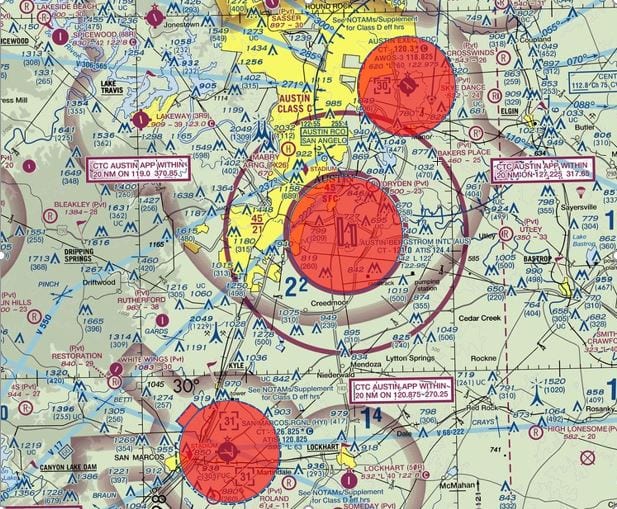
This is the same area but with all of the restrictions from the Blanket COA.
Misconception 2. You have to stay those distances away from any airport.
The next misconception is that people say it’s certain distances from ANY type of airport. This isn’t true. The Blanket COA is only for those “public use airport, heliport, gliderport, or seaport listed in the Digital – Chart Supplement (d-CS), Alaska Supplement, or Pacific Chart Supplement of the U.S. Government Flight Information Publications[.]” If you look back at the picture, you’ll notice that there are restricted, not public airports, and airports that do not show up in the Chart Supplements.
Misconception 3. You don’t have to report anything if you did not fly.
If you look at Section C, it says,
Documentation of all operations associated with UAS activities is required, regardless of the airspace within which the UAS operates. NOTE: Negative (zero flights) reports are required
Misconception 4. You do NOT have to file NOTAMs.
The document says,
Notice to Airmen (NOTAM).
A distant (D) NOTAM must be issued when unmanned aircraft operations are being conducted.
This requirement may be accomplished:1. Through the operator’s local base operations or NOTAM issuing authority, or
2. By contacting the NOTAM Flight Service Station at 1-877-4-US-NTMS (1-877-487- 6867) not more than 72 hours in advance, but not less than 24 hours prior to the operation, unless otherwise authorized as a special provision. The issuing agency will require the:
a. Name and address of the pilot filing the NOTAM request.
b. Location, altitude, and/or operating area.
c. Time and nature of the activity.
d. Number of UAS flying in the operatingarea.
3. The area of operation defined in the NOTAM must only be for the actual area to be flown for each day and defined by a point and the minimum radius required to conduct the operation.
4. The operator must cancel applicable NOTAMs when UAS operations are complete or will not be conducted.
Aviation Attorney. FAA Certificated Commercial Pilot and Flight Instructor (CFI/CFII). Contributor at Forbes.com for Aerospace and Defense.